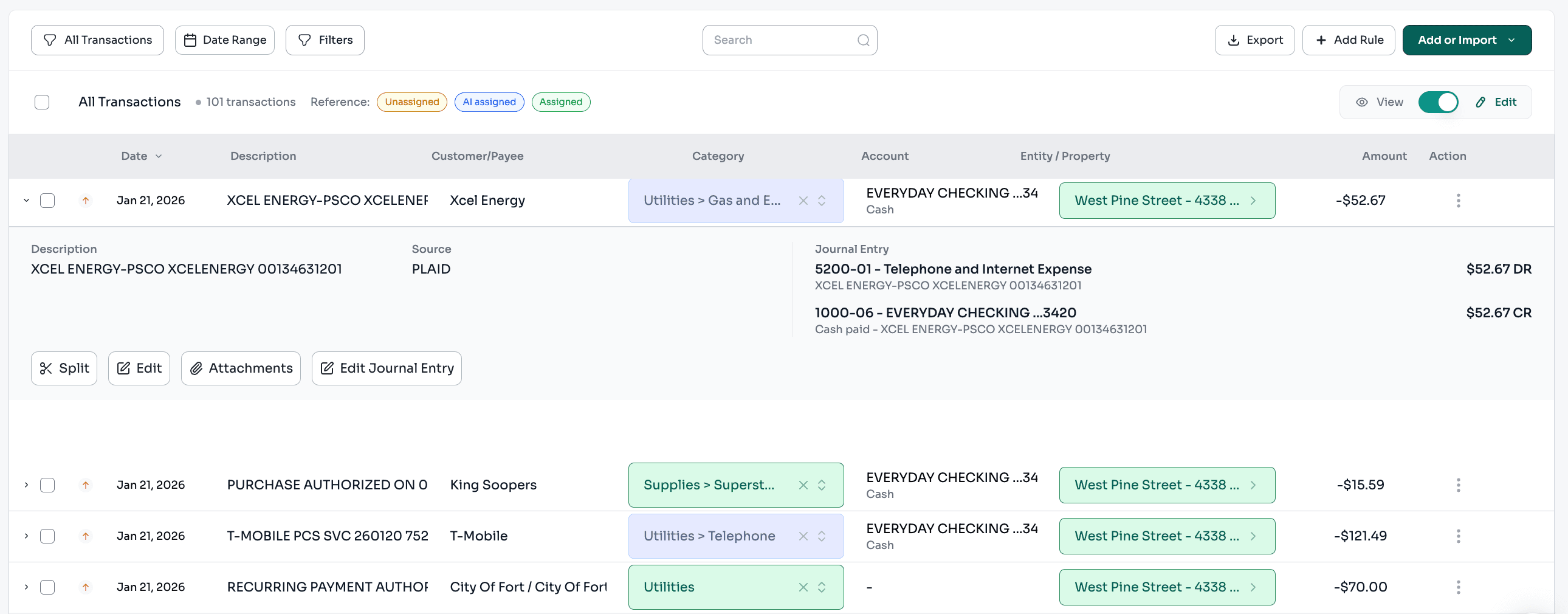
QuickBooks is a capable general ledger — and it waits for you. Ledgre is a general ledger with an agent operating it: reading your statements, posting property-by-property, and bringing you only the calls it genuinely can't make.
Create your accountNone of this is QuickBooks being bad software. It's QuickBooks being a tool rather than an operator.
Every month someone opens it, reviews the feed, categorizes the pile, chases the receipts, and fixes the splits. QuickBooks is very good at recording what you tell it. It has no opinion about what you haven't told it yet.
Properties become classes. Entities become separate files. Units become memo fields. It works, until the portfolio grows and every report needs a person who remembers the conventions.
A mortgage payment splitting into principal, interest, escrow, and fees is exactly the entry QuickBooks won't do for you — and exactly the one that quietly goes wrong for a year.
Your CPA, your partner, your property manager — each one is another seat. The people who should be looking at your books are the ones it costs you to add.
Same double-entry discipline underneath. A different answer to who operates it.
New activity arrives from your connected accounts and uploaded statements and becomes work the agent picks up. You see what it couldn't resolve, not everything it could.
Properties, units, entities, leases, tenants, lenders, and loans are first-class. Every journal line carries them, so per-property and per-entity reporting is a filter, not a rebuild.
Mortgage statements, 1098s, closing disclosures, property tax bills, insurance declarations, rent rolls. Every amount it pulls is checked against the document's own text before it posts.
Trial balance, P&L, balance sheet, general ledger, Schedule E, and rent roll — by property or entity, exported to PDF, Excel, or CSV.
Where the two actually differ for rental property books.
| Feature | Ledgre | QuickBooks |
|---|---|---|
| Who does the categorizing | An agent, continuously | You, or rules you maintain |
| Reads statements you upload | PDF, CSV, and Excel | CSV import, mapped by hand |
| Mortgage statements and 1098s | Read and posted, principal/interest split | Manual journal entries |
| Amounts checked against the source document | ||
| Uncertain items | Become review cards that explain themselves | Sit in an uncategorized pile |
| Your corrections become standing rules | Rules you write and maintain | |
| Property, unit, entity, lease, and loan on every entry | Built in as dimensions | Class and location workarounds |
| Multiple owner entities | One workspace, reportable separately | A separate file per entity |
| Schedule E | Generated from the ledger | Custom report you build |
| Rent roll | Built in | |
| Depreciation | Tracked from asset context | Add-on or manual |
| Double-entry ledger and audit trail | Yes — agents post through it, not around it | Yes |
| Users | Unlimited, included | Per-user fees |
| Monthly cost | Free | $30–200+ |
No class-tracking conventions to remember. Every entry already knows which property, unit, entity, lease, and loan it belongs to.
The reasons we hear most on demo calls:
Ledgre starts from your last clean close and runs forward: connect your accounts, upload what you have, and the agent builds from there. There's no years-of-history import to survive — and if your prior years do need cleaning up first, say so on a demo and we'll scope it honestly.
“Makes bookkeeping for my rentals so much easier than before. It's so clean and organized it's making me actually excited to prepare my taxes.”
“Clean, intuitive, well-designed software for rental accounting and tax purposes. Would recommend to those looking for a tool that is easy to learn and set up.”
“Software is very well designed to keep track of rental accounting and tax purposes and easy to use! Highly recommend! Plus, the owner of the company is really nice!”
The software is free — every feature, unlimited properties, unlimited users. Start now.